

For years, locum tenens staffing has often been viewed as the solution you call when something has already gone wrong: a physician resigns unexpectedly, a vacancy remains open, or a department suddenly needs coverage.
That reactive approach misses the bigger opportunity.
Healthcare organizations are increasingly using locum tenens as one component of a broader workforce strategy. Instead of waiting for a staffing gap to become an operational crisis, organizations can use temporary clinicians strategically to manage demand, support existing teams, maintain access to care, and create flexibility while long-term workforce plans take shape.
Locums should not replace permanent hiring or become the default answer to every vacancy. But when used intentionally, they can provide an important layer of flexibility in an increasingly unpredictable healthcare environment.
The traditional model is straightforward:
A provider leaves → a position opens → recruitment takes longer than expected → the team becomes stretched → locums are brought in to fill the gap.
There is nothing inherently wrong with using locums this way. In many cases, temporary coverage is exactly what an organization needs.
The problem is waiting until the organization is already under pressure.
When a team is operating short-staffed for an extended period, remaining clinicians may take on additional shifts, patient wait times can increase, and leaders may have fewer options for responding to changing demand.
A workforce strategy that anticipates these pressures can use locum tenens before a vacancy becomes a crisis.
Temporary clinicians can play several roles within a larger workforce plan.
Managing Rising Patient Demand Patient volume does not always increase at a pace that permanent hiring can match.
Organizations may experience unexpected growth in a market, an increase in referrals, or higher utilization within a particular service line. Recruiting and onboarding a permanent provider can take months.
Locums can provide coverage while an organization evaluates whether increased demand is temporary or represents a long-term need.
Some staffing needs are seasonal or predictable.
Organizations may need additional providers during periods of higher patient volume, holidays, seasonal illnesses, or planned service expansions. Instead of permanently increasing headcount to accommodate temporary demand, leaders can use flexible staffing to match workforce capacity with actual need.
Burnout is not simply an employee satisfaction issue. Persistent understaffing can affect scheduling, productivity, retention, and the overall stability of a clinical team.
Temporary coverage can give an overextended team additional capacity while leaders work on longer-term solutions.
The goal is not to use locums indefinitely to compensate for structural workforce problems. It is to provide enough flexibility to prevent short-term pressure from becoming a long-term staffing problem.
Workforce needs are not always organization-wide.
A health system may have adequate coverage overall but still face a shortage in a particular specialty, location, or service line.
Locums can provide targeted support where it is needed rather than requiring an organization to make a permanent staffing investment before the long-term need is fully understood.
Permanent recruitment can take time, particularly for hard-to-fill specialties and markets.
Rather than leaving a position uncovered while recruitment continues, organizations can use locum tenens to maintain coverage during the search.
This creates a bridge between the immediate staffing need and the long-term hiring decision.
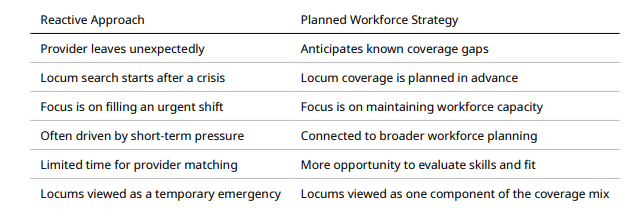
The distinction is not whether an organization uses locums.
It is how and why the organization uses them.
A strategic approach also means knowing when temporary staffing is not the right answer
If an organization has a persistent vacancy that it expects to need indefinitely, relying exclusively on locums may not address the underlying workforce problem.
Similarly, if a service line consistently requires more coverage than its permanent workforce can provide, leadership should evaluate whether the long-term staffing model needs to change.
Locums can create flexibility, but they should not be used to avoid necessary decisions around permanent recruitment, retention, compensation, scheduling, workload, or organizational design.
The strongest workforce strategies use temporary staffing alongside those efforts—not instead of them.
Before determining whether locums are appropriate, healthcare leaders can evaluate five questions:
Healthcare workforce planning is becoming less about choosing between permanent employees and temporary clinicians and more about creating the right combination of coverage models.
Permanent providers can provide continuity and long-term stability.
Locum tenens can provide flexibility.
Internal teams can provide organizational knowledge and consistency.
Other workforce models can help address specific geographic, specialty, or demand-related needs.
The right mix will look different for every organization.
The key is to stop thinking about locums only as the staffing solution for something that has already gone wrong.
When incorporated thoughtfully, locum tenens can help organizations respond to changing demand, protect clinical teams from excessive workload, maintain access to care, and bridge the gap between today's staffing needs and tomorrow's workforce.
Review your organization's coverage mix. Consider where temporary staffing could provide flexibility, where permanent recruitment remains the priority, and where the two strategies can work together.
Locum tenens does not have to be the emergency button.
It can be part of the plan.