

Allied health professionals are the undisputed backbone of the modern healthcare system. From respiratory therapists managing life-saving ventilators in the ICU to radiologic technologists capturing critical diagnostic imaging, and clinical laboratory scientists processing urgent bloodwork—these essential team members keep hospitals, clinics, and outpatient centers running safely and efficiently. Yet, despite their massive impact on patient outcomes and facility revenue, allied health recruitment often operates in the shadows, receiving significantly less attention and strategic investment than physician or registered nurse hiring.
The reality is that allied health hiring is incredibly complex. The term "allied health" encompasses dozens of highly distinct clinical modalities, each with its own specific credentialing requirements, state licensing boards, educational pathways, and competitive market dynamics. A recruitment strategy that works for physical therapists will not necessarily work for surgical technologists or MRI technicians.
Healthcare organizations are currently facing severe shortages across these vital specialties. To remain fully operational and maintain high standards of patient care, HR directors, department managers, and healthcare recruiters must modernize their approach. This requires shifting from a reactive, transactional hiring model to a proactive strategy focused on building a sustainable healthcare talent pipeline.
In this comprehensive guide, we will break down everything you need to know about allied health recruitment and allied health retention. From auditing your current workforce and writing compelling job descriptions to executing a flawless onboarding process and building long-term career ladders, this is your blueprint for staffing success.
Before you can build an effective recruitment strategy, you must intimately understand your facility’s unique staffing landscape. Taking a proactive approach to your allied health talent pipeline begins with a thorough audit of your current and future needs. Because allied health covers such a broad spectrum of disciplines, a generalized staffing plan will inevitably fall short.
The first step is conducting a granular, role-by-role analysis of both your internal workforce and the local talent supply. You need to know exactly how difficult it will be to source candidates for specific modalities in your region.
Look at your historical hiring data to identify patterns. Which departments consistently struggle with high vacancy rates?
The healthcare industry is aging. Many highly specialized allied health professionals—such as seasoned cytotechnologists or dosimetrists—are approaching retirement age.
In a candidate-driven market, a generic job description is a missed opportunity. Your job posting is often the first interaction a clinician has with your employer brand. If it reads like a dry list of HR requirements, top-tier talent will scroll right past it. To excel in allied health hiring, your postings must be highly specific, candidate-centric, and optimized for conversion.
Do not use blanket titles like "Imaging Technologist." Allied professionals are highly specialized and want to know exactly what the role entails. Use specific titles such as "MRI Technologist - Outpatient Neuro" or "Pediatric Respiratory Therapist." The more precise the title, the better it will perform in search engine results and job board algorithms.
Lack of schedule transparency is a major red flag for clinical job seekers. Be upfront about the realities of the shift.
For many allied health professionals, the equipment they use is a massive factor in job satisfaction. A CT technologist wants to know if they will be working on a state-of-the-art 256-slice scanner or an outdated model.
Allied health is inherently collaborative. A solitary physical therapist running a small rural clinic has a vastly different day-to-day experience than a therapist working in a massive 50-person rehabilitation department at a Level 1 Trauma Center. Mention the size of the team, the physician-to-staff ratio, and the interdisciplinary nature of the work. Emphasize a culture of safety, respect, and continued learning.
Once your optimized job postings attract qualified candidates, your interview process must effectively evaluate both clinical competency and cultural alignment. A bad hire in an allied health role can disrupt team morale, stall departmental workflow, and, worst of all, compromise patient care.
While credentialing and licensure verify a baseline of knowledge, the interview must probe deeper into a candidate's actual clinical comfort level.
Allied health professionals constantly interact with patients—often during highly vulnerable moments—as well as with nurses, physicians, and administrators.
Use the interview to understand the candidate's long-term trajectory. Are they looking for a stable, predictable role to stay in for the next ten years, or are they hungry for leadership and advanced certifications? Aligning their personal career goals with your facility's reality is the first step toward long-term allied health retention.
Incorporate peer interviews into the selection process. Having a candidate speak directly with a future colleague (without management present) serves two purposes: it gives your current staff a voice in who joins their team, and it gives the candidate a highly authentic view of the day-to-day work environment.
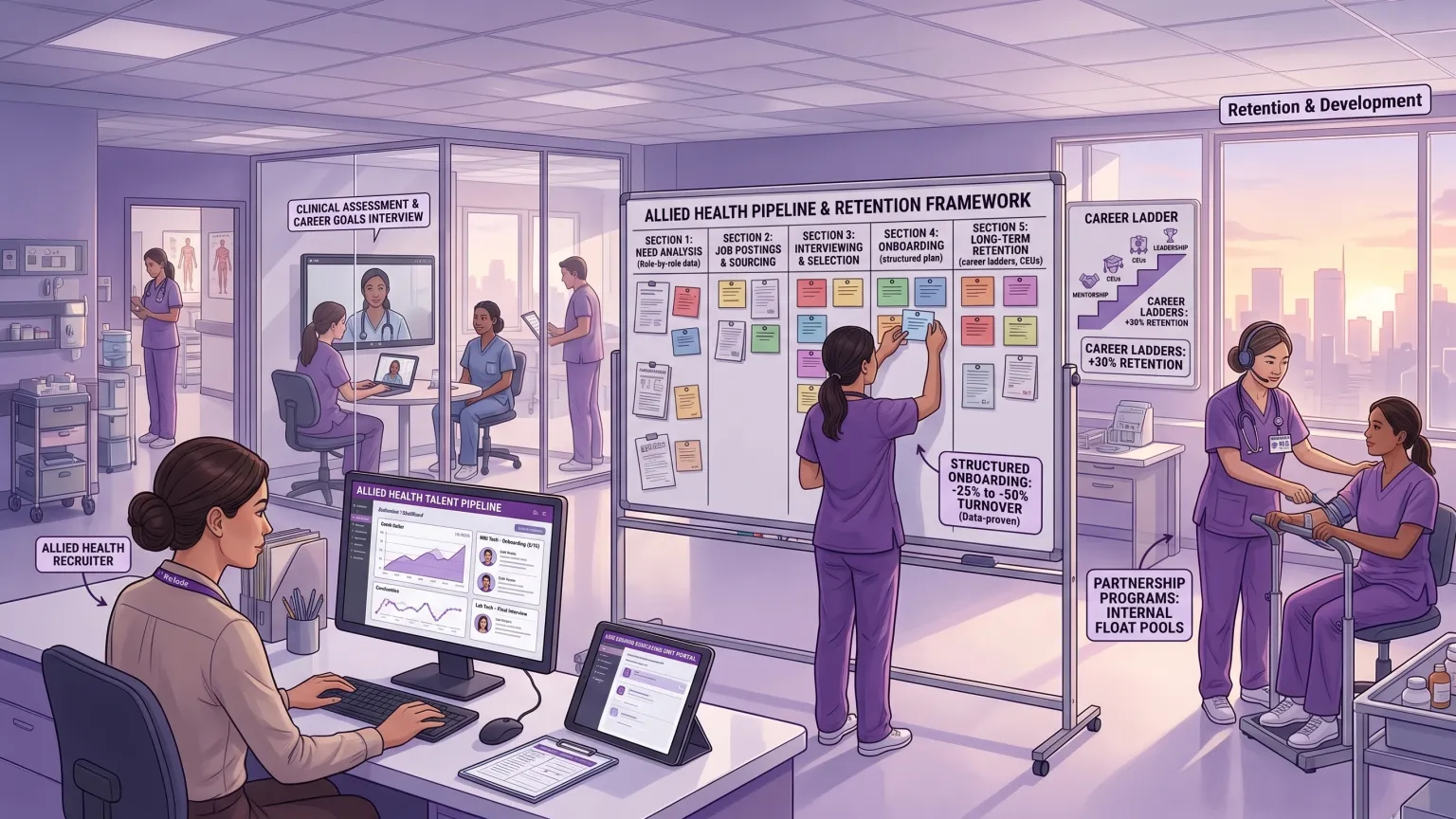
The recruitment process does not end when the candidate signs the offer letter; it ends when the employee is fully integrated and independently contributing to the team. Unfortunately, many healthcare facilities rush onboarding due to critical staffing shortages, throwing new hires directly onto the floor. This is a costly mistake. Research shows that structured onboarding reduces first-year turnover by 25-50%.
A disorganized orientation leads to immediate candidate buyer’s remorse. Your onboarding program should be a heavily structured, clearly communicated roadmap covering the first 90 days.
Assign every new allied health hire a dedicated preceptor or mentor. This should be an experienced clinician who is specifically trained (and compensated) to teach. A strong preceptor not only ensures clinical protocols are followed but also acts as a cultural ambassador, helping the new hire navigate team dynamics, locate supplies, and feel socially integrated into the unit.
Do not wait for the annual performance review to provide feedback. Implement formal check-ins at day 30, day 60, and day 90. These meetings should be two-way streets. Ask the new hire:
While a strong onboarding program secures the first year, long-term allied health retention requires a sustained strategy. If professionals feel they have hit a ceiling in your organization, they will inevitably leave for a facility that offers growth. Industry data and multi-year studies demonstrate that robust career ladder programs improve allied health retention by 30% or more.
Many allied health roles suffer from a lack of obvious upward mobility. If a rad tech knows they will have the exact same title and responsibilities in ten years, complacency sets in. Create structured clinical ladders (e.g., Tech I, Tech II, Tech III, Lead Tech) that reward experience, advanced skills, and leadership. Tie these advancements to meaningful pay increases and distinct changes in responsibility, such as taking on preceptor duties or managing equipment QA.
Healthcare is an ever-evolving field. Allied health professionals must maintain their licenses through continuing education units (CEUs).
Burnout is rampant in healthcare. The facilities that win at retention are the ones that offer creative scheduling solutions.
Even with a flawless recruitment and retention strategy, there will be times when your permanent staff cannot cover the clinical demand. Knowing when to deploy contract professionals (travelers) versus when to hold out for a permanent hire is a critical skill for managing both patient care and budget.
Contract allied health professionals are highly skilled, adaptable clinicians who can step into a facility and be productive almost immediately. You should utilize contract staffing for:
While travelers are excellent for temporary fixes, relying on them as a long-term staffing solution is financially unsustainable and can disrupt team continuity.
Recruiting and retaining allied health professionals requires far more than posting a job on a generic board and waiting for resumes. It demands a systematic, highly targeted approach that respects the unique specialties, market demands, and career aspirations of these critical clinicians. By mapping your precise needs, writing optimized postings, standardizing clinical interviews, investing heavily in the first 90 days of onboarding, and creating visible career ladders, you will fundamentally transform your hiring outcomes.
A strategic approach to allied health talent pays for itself exponentially in reduced vacancy times, decreased reliance on premium contract labor, and, most importantly, consistent, high-quality patient care.
As the complexities of the healthcare labor market continue to evolve, you don't have to navigate it alone. Partnering with a modern, tech-enabled staffing expert can give you the competitive edge you need to secure top-tier allied health talent faster.
Build your allied health talent pipeline with Relode. Contact us today to learn how our intelligent recruitment platform and industry expertise can solve your toughest hiring challenges.
Q: What's a good time-to-fill for allied health roles?
A: A healthy time-to-fill metric for standard allied health roles—such as phlebotomists, medical assistants, or general X-ray technologists—is typically between 30 to 60 days. However, for highly specialized or severe shortage modalities (such as echocardiographers, specialized dosimetrists, or experienced cytotechnologists), organizations should anticipate a time-to-fill of 60 to 120 days. Planning ahead for these specialized vacancies is absolutely critical.
Q: How do we reduce agency spend for allied health departments?
A: The most effective way to reduce premium agency spend is by building internal float pools and establishing pipeline partnerships. An internal float pool allows you to train and pay your own permanent staff a slight premium to float between different clinics or hospital campuses, keeping the money in-house rather than paying high agency markups. Additionally, forming strong pipeline partnerships with local community colleges and allied health training programs ensures you have first access to new graduates, allowing you to hire and mold talent before they enter the open market.